

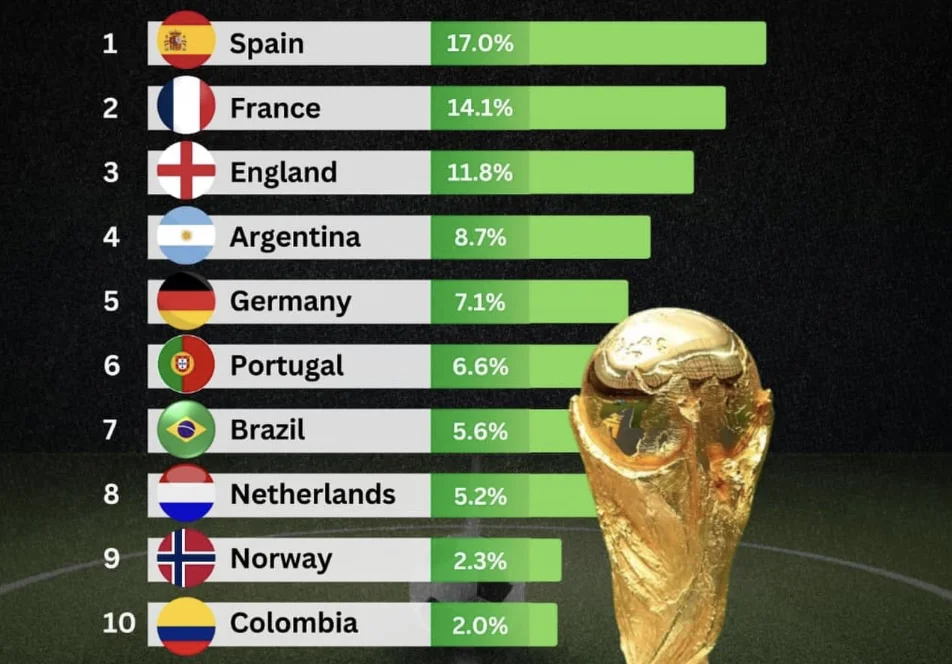
The numbers
The strongest statistical models and market-based projections place Spain first with around 16–17% title probability, ahead of France at roughly 12.8–14.1%, England at about 11.8–11.4%, Argentina near 8.7–10.3%, and then Portugal, Brazil, and Germany behind them. FIFA’s updated ranking on the opening day of the tournament also shows the top tier very tightly packed, with Argentina, Spain, France, England, Portugal, and Brazil all sitting near the top of the world rankings. That matters because at this level, small differences in squad depth, defensive stability, and tournament experience usually decide the outcome.
Spain’s case
Spain look strongest because they combine elite technical quality with balance in every line. Their squad is built around Rodri, Pedri, Lamine Yamal, Nico Williams, Fabian Ruiz, Mikel Merino, and Unai Simón, which gives them control in midfield, creativity on the wings, and enough defensive structure to survive tight knockout matches. They also come into the tournament as European champions and have been rated the top favorite by Opta-style models, which is a strong sign that their recent performance level is not just a reputation effect. The biggest reason to trust Spain is that they are less dependent on one star than most rivals; even if one player is marked out of a game, they can still dominate possession and create chances through multiple routes.
France’s case
France are the most dangerous alternative because their squad ceiling is enormous. Kylian Mbappé and Ousmane Dembélé headline a group that also includes Michael Olise, Désiré Doué, Theo Hernández, William Saliba, Dayot Upamecano, and Mike Maignan, giving them pace, creativity, and world-class athleticism in every department. Their attack looks especially explosive, and Mbappé remains the type of player who can carry a knockout run almost by himself if he gets hot at the right time. The concern is that France can sometimes look more dangerous in transition than in total control, so they are a little more dependent on game state than Spain.
England and Argentina
England sit right behind the top two in most projections, but they still have to prove they can turn talent into a title run. Their squad is deep and loaded with Premier League-level quality, yet in recent major tournaments they have often lacked the same coherence that Spain and France show in their best spells. Argentina, meanwhile, remain the defending champions and still rate highly because of their tournament temperament and winning experience, but their model probability is lower than the top three, which suggests that the bracket and the age curve make back-to-back titles harder than it looked in 2022. In pure knockout terms, Argentina still have the mentality to go far, but they are no longer the obvious No. 1 choice.
How the bracket can matter
In a 48-team World Cup, the path to the final can matter almost as much as raw strength. The new structure adds a round of 32 and increases the chances that one of the top teams gets an awkward early opponent, a difficult travel pattern, or a physical upset game that drains energy before the quarters. That slightly favors teams with deeper squads and better control of matches, which is another point in Spain’s favor because they can manage tempo better than most sides. France are also well suited to chaotic brackets because they can win ugly, but Spain’s style is usually easier to sustain across multiple rounds.
Dark horses
If the main favorites stumble, Portugal, Brazil, Germany, the Netherlands, and even Norway are the teams most likely to exploit it. Portugal have elite attacking quality, Brazil still have the talent to explode in a knockout tournament, and Germany are always dangerous when their structure clicks. The surprise candidates like Norway are more about making a run deep into the tournament than about being the most likely champions, but that is exactly what makes the expanded format interesting. In other words, the new World Cup increases the number of credible contenders, but it does not change the fact that the title should still come from the very top tier.
Final prediction
If I base the forecast on the current numbers, squad quality, and the most likely tournament path, Spain have the highest chance to win the 2026 World Cup. France are the strongest threat, England are the most likely to benefit if the bracket opens up, and Argentina remain the most dangerous champion-type team outside the top three. My final prediction: Spain will be the 2026 World Cup champions.